The $732 Birthday Dinner Bill — What Loud Budgeting Looks Like at the Table
Published 2026-05-21

✨ Quiz
Gen Z Money Style
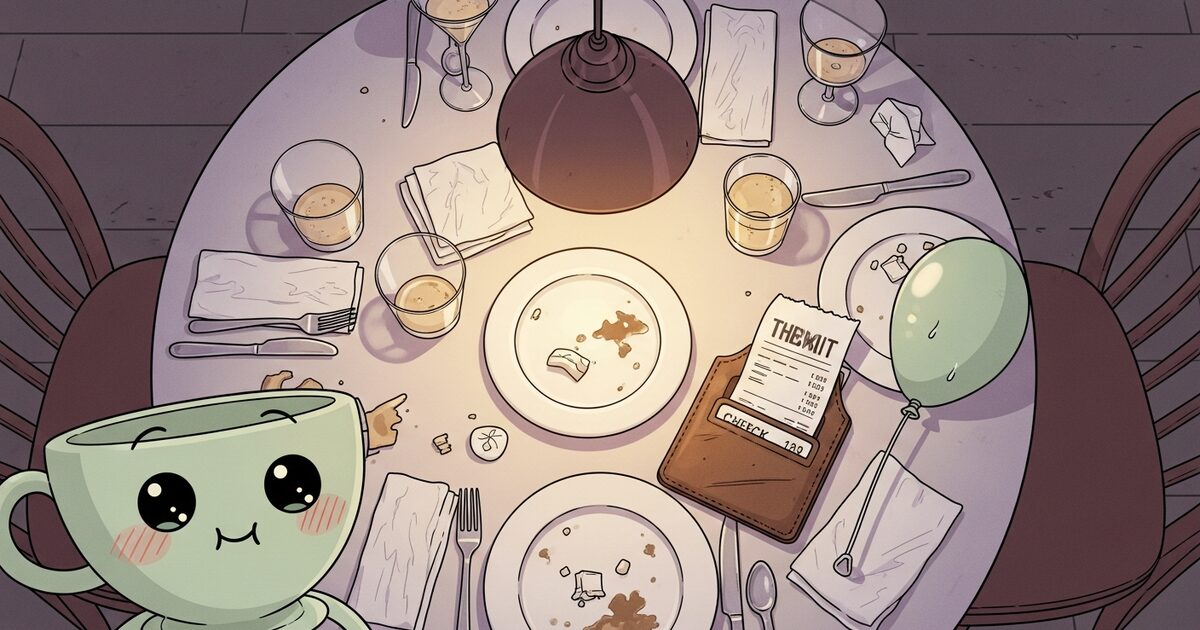
A woman named Brianna posted a TikTok in early May about a birthday dinner she'd been invited to at a Mediterranean spot in West Hollywood. Six girls, one of them turning 26. Brianna ordered a $19 chicken kebab and a glass of water. Three other girls ordered two cocktails each, the wagyu tasting flight, the truffle pasta, and the $90 caviar. When the bill came, the birthday girl announced — cheerfully — that everyone was splitting it evenly. The total was $732.
Brianna paid her $122 share, walked to the parking garage, and cried in her car. Then she made a TikTok about it. Twelve million views and a comment section that read like a courtroom split fifty-fifty on whether she should have spoken up.
This is the dinner that turned loud budgeting from a personal finance trend into a social etiquette movement. And it's why the rule has shifted: in 2026, the awkwardness isn't asking to pay for your own meal. The awkwardness is not asking and paying $103 for someone else's tuna tartare.
What Loud Budgeting Actually Is
Loud budgeting got named in early 2024 by a TikTok creator named Lukas Battle, who was tired of pretending he had money he didn't have so his friends wouldn't think he was struggling. The original frame was simple: "I can't, I'm loud budgeting" — a one-line refusal that flips the social script. Instead of inventing an excuse ("I have a thing that night"), you state the actual reason without apology. Brit + Co and WalletHub both clocked it as the trend that finally killed the era of pretending.
The reason it works: vulnerability beats avoidance. If you say "I can't afford that this month, can we do something cheaper" — the friend who actually likes you will say "oh totally, let's do drinks instead." The friend who doesn't react well to that sentence is telling you something important about the friendship.
But the dinner-table version of loud budgeting is harder than the group-chat version. At the table, you're already there. The wagyu is already ordered. You're trying to negotiate a bill that's already been generated by other people's choices.
That's the gap the $732 dinner exposed. Loud budgeting works on the front end — before the reservation, before the menu opens. By the time the check arrives, you've already lost.
Three Awkward Scenarios and the Loud Budgeting Line for Each
These are the three table situations everyone has hit in the last 12 months. The scripts are short on purpose. Long scripts get edited by your own anxiety in the moment.
Scenario 1: The Surprise Expensive Restaurant Pick
Your friend's birthday and she picks a steakhouse where the entrées start at $58. The group chat goes "yay!" and you're calculating whether you can afford one entrée plus tip.
The line, sent in the group chat 48 hours before: "Quick money note before I forget — I'm out at $80 for the night including tip. If we end up over that I'll Venmo my share separately. Stoked to celebrate!"
What this does: pre-announces your ceiling, frames it as logistics not drama, and ends warmly so nobody thinks you're picking a fight. By the time you're at the table, your boundary is already in writing and you don't have to re-pitch it under cocktail pressure.
Scenario 2: The Friend Who Orders Five Cocktails to Your Tap Water
You're at dinner. You ordered the $18 pasta and drank tap. She ordered $76 in cocktails plus appetizers. She suggests an even split.
The line, said calmly to the table: "Hey, can we Venmo individually tonight? I had a light meal and don't want anyone subsidizing me — but also don't want to round up someone else's drinks. Easier on everyone."
The framing trick: phrase it as fairness to her, not protection of you. "I don't want anyone subsidizing me" makes you sound generous. "I don't want to subsidize anyone" makes you sound stingy. Same logical content, opposite social read.
Scenario 3: The Destination Birthday
The bachelorette / 30th / "girls' trip" that's now $2,400 with the Airbnb, the dinners, the activities, the matching outfits. You love her. You can't afford it.
The line, sent 1:1 to the birthday girl 6+ weeks out: "I'm so excited for your weekend and I want to be there for the part I can swing. Can I do the Saturday dinner and skip the Airbnb / Friday activity? I'd rather show up for one day than ghost the whole thing."
The reason this works: you've named what you can do, not just what you can't. People don't actually want a yes-or-no. They want a counter-proposal. And the birthday girl now has the option to be a good friend back ("of course, come Saturday") instead of being put on the defensive.
Five More Scripts You Can Actually Use
The reason loud budgeting fails for most people isn't philosophy — it's that they don't have the sentence ready. So here's a vocabulary list. Copy these. Reword them in your voice. Save them in a note titled "money lines" so the next time you need one you don't have to invent it under pressure.
1. Pre-emptive (sent before the plan exists): "Putting this here early — I'm in a no-spend month, so I'm down for free or cheap hangs only. Park / walk / cheap takeout vibes."
2. At the moment of ordering: "Just heads up I'm doing the cheapest entrée and skipping drinks — don't let me hold the group back, order normally."
3. When someone tries to "treat": "That's sweet but I'd rather pay my own — saves the next-round-is-on-me energy."
4. The post-bill recovery: "Can I Venmo you my actual share? $40 not $103, I drank water and shared one plate." (Sometimes you have to say this after — the post-dinner Venmo correction is its own loud budgeting move and it's allowed.)
5. The hard one — the friend who keeps not getting it: "I love you and I notice I keep being the only one ordering small. Can we plan around what I can afford for the next one? It would mean a lot."
That last one is the script most people skip because it crosses the line from logistics into a relationship conversation. But it's also the only one that actually changes the pattern. If your friend group has a money-blind spot, you have to make the blind spot visible. Once. Out loud.
Why "Birthday Person Picks, Everyone Pays" Is the Default — and Why It's Breaking
The reason these dinners keep going wrong is a generational mismatch in unspoken rules. The Millennial-era default was: birthday person picks the restaurant, everyone goes, the group splits the bill evenly because the birthday person "shouldn't have to count." That rule worked in 2014 when the average dinner out was $45 a head and most of the group made roughly the same money.
In 2026 it doesn't work. Restaurant prices in major cities are up 40-60% post-pandemic. Friend groups are also more income-diverse than they were 10 years ago — your college friend group might contain a tech IC making $240k and a freelance illustrator making $32k. "Just split it" treats those two people as the same person. They aren't. The bill is the same dollar amount; the cost is wildly different.
Loud budgeting is the etiquette upgrade for this. It restores the missing variable: what each person can actually afford right now. The new rule isn't "everyone splits." It's "everyone says their number ahead of time and the plan respects it." That's slower. It's also why fewer friendships die over dinners.
The Quiet Cost of Not Doing This
Here's what happens when you don't loud budget: you say yes to the dinner, pay the $122, resent it on the way home, post-mortem it with a different friend, decline three of the next five invitations without explaining why, and slowly start removing yourself from the group. Six months later you're "not really close with that crew anymore" and you don't quite know what happened.
What happened is: you let one unspoken expense compound into a withdrawal. Loud budgeting isn't about being cheap. It's about not letting money quietly end a friendship that money could have not ended if you'd named the number.
Pick the next group dinner on your calendar. Send the loud-budgeting line before you arrive. See what happens. (Spoiler: nothing bad. The friends who'd judge you for it are usually the ones who were going to over-order anyway.)
Want to know which money script you're running on right now — the over-spender, the resenter, the silent withdrawer, or something else? The Gen Z Money quiz figures it out in four minutes and the result tends to explain a lot of the dinners you've already paid for.