Bedtime Stacking Is Why You're Tired — Stop Revenge-Scrolling Yourself
Published 2026-05-21

✨ Quiz
What's Your Psychological Age?
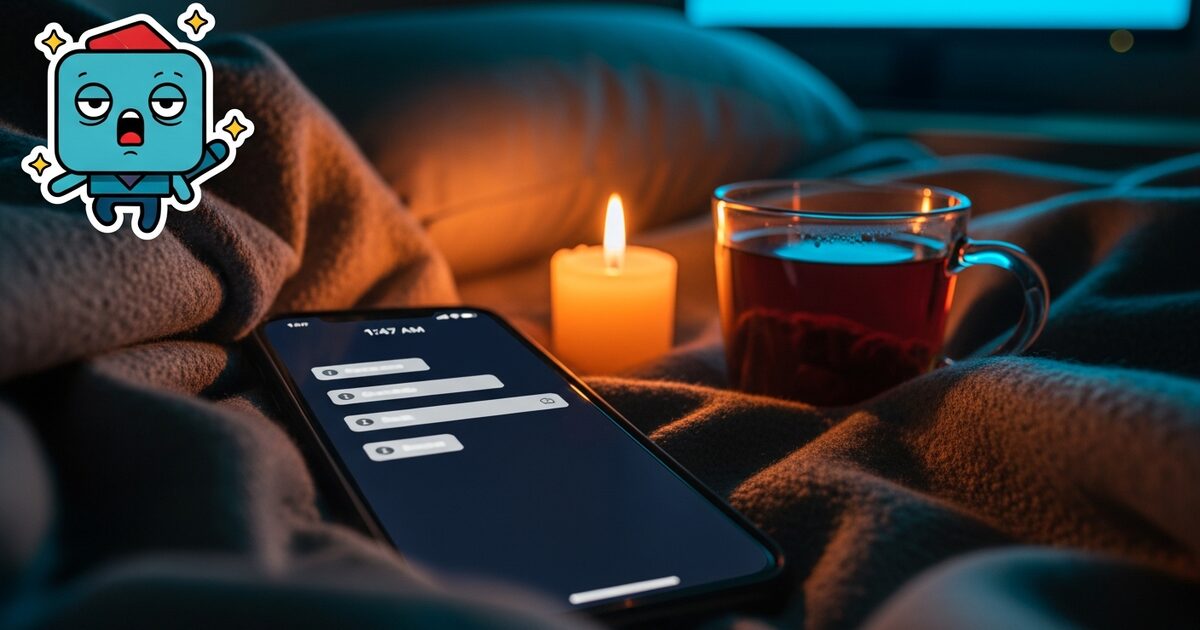
It was 1:47 AM on a Tuesday and my phone was propped against a candle that had gone out forty minutes earlier. I had a sheet mask on, a TikTok playing about whether Aries men are emotionally unavailable, a half-written text to my sister in drafts, a 7-step skincare lineup beside the pillow, and a tab open to a Google Doc titled "tomorrow plan." I had gotten into bed at 11:15.
That's bedtime stacking. The sleep doctors named it in early 2026 and the name stuck because everyone instantly recognized themselves in it. The American Academy of Sleep Medicine reported 93% of Gen Z stay up past their intended bedtime because of phones. Tom's Guide's board-certified sleep doctor warned the bed has too many jobs. Newsweek's revenge-bedtime piece put a name on the rage underneath it — the feeling that the only hour of the day that's yours is the hour you should be asleep.
Both things are true. The bed has too many jobs. And we're stealing back the day on the only frontier left.
The Bed Has 14 Jobs and None of Them Is Sleeping
Let me list everything I have done in my bed this week: answered three Slack messages, ate a microwave dumpling, watched 40 minutes of a documentary about cult survivors, applied a chemical peel, FaceTimed my mom, journaled for nine minutes, cried once, gossiped with my best friend on voice memo, planned my outfit for Saturday, online-shopped a $32 candle I don't need, scrolled Zillow listings in cities I won't move to, read four chapters of a romantasy book, wrote half a cover letter, and yes — sometimes — slept.
This is the trap the sleep doctors are flagging. The brain learns associations by repetition. When the bed becomes the office, the dining room, the therapy chair, the salon, and the cinema, your nervous system stops recognizing it as the sleep place. By the time you actually try to fall asleep, your body is on alert. It's waiting for the next task. Sleep doesn't arrive because the bed hasn't signaled "off."
This is why people who never had insomnia three years ago suddenly do, and why their tracker says they "fell asleep" at 11:30 but feel hung over at 7:15. They didn't sleep. They lay still under stimulation while the brain stayed half-on.
The 5 Behaviors Stacking on Top of Each Other
There's a reason your bedtime keeps drifting later even when you didn't decide to stay up. Each behavior makes the next one feel reasonable.
1. Scrolling. The doom-scroll. TikTok, Reddit, Instagram, whatever the algorithm hands you. Average Gen Z user scrolls 35 minutes in bed after lights-off, per the AASM report. Each video resets your dopamine baseline.
2. Skincare. The 7-step routine that turned into 11 steps because someone on TikTok said you needed an acid exfoliant on top of retinol. Skincare is real — it just doesn't have to happen in bed. The reason it migrated to bed is because it became content you watch yourself perform.
3. Journaling / "planning tomorrow." Bullet-journaling-style productivity that's actually anxiety in a Moleskine. Listing things you want to do tomorrow is rehearsing tomorrow. Your nervous system reads it as: we're not done yet, stay alert.
4. Texting. The deep-dive group chat. The 1 AM what-do-you-think-this-text-from-him-means consultation. The processing-the-day debrief with your friend across the country. Social bandwidth your day didn't have room for.
5. The Last One Thing. "Just one more episode." "Just one more video." "Let me just check this one app." This is the bedtime-stacking cherry — the behavior that's an exit ritual but always becomes another stack. Your brain learns: bed = the place where I get one more thing.
By the time all five are stacked, it's 1:30 AM. You meant to sleep at 10:45. You're now four hours behind on rest and tomorrow's exhaustion is already booked.
Why Revenge Bedtime Is Actually Rational
Now the harder part. The sleep doctors are technically right that the fix is "stop using your bed for everything." But that advice ignores why we started doing this.
For most Gen Z working adults, the only hour of the day that isn't owed to someone — boss, professor, parent, partner, algorithm — is the hour between when the body is tired and when sleep arrives. Bedtime stacking is autonomy theater. It's the only window where the day's question is "what do I actually want to do right now" instead of "what do I owe."
That's why willpower-based fixes ("just put the phone down!") fail. You can't willpower your way out of a structural problem. If you've been performing all day, the bed is the only place left to be a person. Of course you stack everything into it. The bed is the last unmonitored room.
The fix isn't to give up that hour. The fix is to move that hour somewhere else so the bed can do its one job.
The 2-Rule Fix Sleep Doctors Actually Recommend
This is what Tom's Guide's sleep doctor — and pretty much every CBT-I (cognitive behavioral therapy for insomnia) protocol — comes down to. Two rules, no app, no $400 mattress topper.
Rule 1: Bed is for sleep and sex only. That's it. Everything else moves to literally any other surface in your apartment. The couch. The floor. A chair. A bath. The bed becomes single-purpose. Within 7-10 nights your brain re-associates bed = sleep and you fall asleep faster.
Rule 2: If you want to scroll, scroll on the couch. You don't have to quit scrolling. You don't have to quit skincare or journaling or texting your friend. You just have to do all of it somewhere else. When you're done, you get into bed, and the bed has nothing to offer except sleep. Boredom is the door sleep walks through.
If you genuinely can't move the autonomy hour out of bed (small apartment, roommate situation, partner's already asleep) — fine. Then make the bed dark, put the phone face-down at arm's length, and pick ONE of the five stacked behaviors. Not all five. Just one. Stacking is what breaks the system, not any single behavior.
What This Costs You Physically (Not Just Vibes)
The "tired Gen Z" thing isn't a meme — it's measurable. Chronic late-night blue light exposure suppresses melatonin onset by 30 to 90 minutes per night. Even when you do fall asleep, the first sleep cycle is shorter and less restorative, which is why you can sleep 8 hours and still wake up exhausted.
The cumulative effect is real: sleep debt compounds across a week the same way credit card debt compounds across a month. By Friday, the version of you operating in the world is running on a 4-hour deficit. That's the version that misreads a friend's text as hostile, can't remember why she walked into the kitchen, eats a second dinner at 11 PM, and cries at a Spotify ad. None of that is character. All of it is sleep debt cosplaying as a personality.
There's also the cortisol piece. Stacked bedtime behaviors keep cortisol elevated past midnight, which is why you wake up at 4:13 AM with your heart pounding for no reason. That's not anxiety arriving for no reason. That's your stress hormone never having properly come down. The bed didn't deliver the off-switch.
The Counter-Argument I Hear Most
Whenever I post about bed-is-for-sleep, the same comment shows up: "my apartment is one room, where am I supposed to go." Fair. The counter is: make the bed itself a different surface for the pre-sleep hour. Sit upright. Lights on. Pillow against the wall. The brain partly reads the bed by posture, not just location. Lying horizontal in the dark is the sleep configuration. Sitting upright with the lamp on is the living configuration. Same furniture, different signal.
The other comment: "I do my best work / thinking / processing in bed at night." Also fair. The honest answer is that you can keep one of the five stacked behaviors and let go of the other four. Pick the one that matters most to you — usually it's the texting-with-the-friend or the journaling — and ruthlessly ditch the rest. Stacking is what breaks the system. A single behavior is survivable.
One Week. Try It.
The wild thing about CBT-I research is how fast it works. Most people doing the bed-is-for-sleep rule see measurable change in 7 to 10 days. Not because the rule is magic — because your brain wants to associate the bed with sleep. You've just been overriding it with five different stacks.
Pick one night this week. Couch for everything pre-sleep. Bed only when you're ready to be horizontal in the dark. See how Wednesday morning hits.
If you've been suspicious that the "tired Gen Z" thing isn't laziness but something specific to how you're spending your last hour of the day — you're right. The hour didn't betray you. The stack did. Curious what age your nervous system is actually running on right now? The psychological age quiz reads your stress patterns and tells you which version of yourself the bedtime stacking is feeding.